Strive's SATA preferred stock becomes the world's first daily dividend security starting June 16, 2026. Learn what SATA is, how it works, and what daily dividends mean for investors.
In my analysis of the Bitcoin treasury company space, few announcements have stopped me in my tracks quite like this one. Strive, Inc. has just announced that its Variable Rate Series A Perpetual Preferred Stock — known as SATA — will begin paying daily dividends starting June 16, 2026. That makes it, by Strive's own research, the first listed security in history to do so.
This isn't just a structural tweak. In my view, it's a meaningful redesign of how a Bitcoin treasury company can deliver income to its investors. Let me break down what SATA is, what it was, and why this change matters.
(Source: GlobeNewswire — Strive Announces Daily Dividends on SATA)
What Is SATA? Understanding Strive's Preferred Equity Instrument
Before we get to the big news, I want to make sure we're all on the same page about what SATA actually is.
SATA stands for Variable Rate Series A Perpetual Preferred Stock. It's a class of preferred equity issued by Strive, Inc. (ticker: ASST), a publicly traded Bitcoin treasury company that holds Bitcoin as its primary reserve asset.
The Simple Analogy
Think of SATA like a preferred seat on a plane. You're not flying the plane — that's the common equity (ASST stock) doing the heavy lifting. But as a preferred holder, you get paid first, you get a fixed income stream, and you experience far less turbulence than those in the back.
SATA has a stated par value of $100 per share. It pays a variable annualized dividend rate, which is currently set at 13.00% per annum. The rate is reviewed and can be adjusted monthly.
Key SATA Facts at a Glance
Feature | Detail |
Security Type | Variable Rate Perpetual Preferred Stock |
Stated Par Value | $100 per share |
Current Annual Rate | 13.00% |
Bitcoin Backing |
|
IPO Date | November 10, 2025 |
(Source: Strive Investor Update, May 2026)
What SATA Was Before: Monthly Dividends
When SATA launched in November 2025, it paid its dividend once per month. That's how the vast majority of income-paying securities work — a single payment deposited into your account each month.
On paper, that's not a bad deal. At 13% annualized, a $100,000 SATA position was generating roughly $1,083 per month. That's well above what you'd earn from money market funds (3.9%), T-bills (3.6%), or even high-yield bond ETFs (~6.4%).
The Problem With Monthly: It Creates Volatility
Here's something I found particularly insightful in Strive's investor presentation. Under a monthly dividend structure, trading volume around ex-dividend dates spiked to roughly 2.0x the 20-day baseline. Then it collapsed back to below-average levels.
That pattern isn't just noise — it's structural. Investors pile in before the ex-div date to capture the payment, then rotate out. The dividend mechanism itself was described by Strive as "the largest non-fundamental driver of SATA price action today."
In other words, the monthly cadence was actually introducing volatility into a product designed to be a lower-volatility income vehicle.
The Big Change: SATA Goes Daily
Starting June 16, 2026, SATA will begin paying dividends every single business day. That's approximately 250 payment events per year, compared to 12 under the old structure — roughly 21 times more touchpoints.
The math doesn't change the total annual payout. What changes is how that payout is delivered.
The Daily Dividend Formula
The calculation is straightforward:
Daily Dividend = Stated Amount × Annual Rate ÷ 12 ÷ Business Days in Month
For July 2026 (22 business days), that works out to approximately $0.04924 per share per business day for a $100 par SATA position.
At the end of the month, those daily payments sum to exactly the same monthly total you'd have received before — roughly $1.0833 per share. Same total. Smoother path.
Three Reasons This Is Groundbreaking
Strive has framed the upgrade around three key improvements: Higher APY, Less Volatility, and More Utility. Let me walk through each one.
1. Higher Effective APY Through Daily Compounding
The stated dividend rate of 13.00% doesn't change. But daily compounding produces a marginally higher Annual Percentage Yield (APY).
Compounding Frequency | Effective APY |
Annual | 13.0000% |
Monthly | 13.8032% |
Daily (250 days) | 13.8790% |
The lift from monthly to daily is approximately +7.57 basis points of APY. That sounds small — and it is on a single share. But Strive's analysis shows that on a $100 million position, daily compounding adds roughly $76,000 in year one and around $2.4 million cumulatively over ten years — before any reinvestment.
At institutional scale, these incremental gains matter enormously.
2. Less Volatility by Eliminating the "Event"
This is the insight I found most analytically compelling. Under monthly dividends, there are 12 concentrated cash-flow events per year. Every one of those events creates a predictable trading opportunity — and the data shows traders exploit it.
By switching to daily payments, Strive is effectively dissolving the ex-dividend event. When every single business day is an ex-div day, no single day matters more than any other. The result, per Strive's thesis, should be more consistent liquidity and lower realized price volatility.
For context: SATA already has dramatically lower volatility than ASST common stock. Annualized volatility since IPO has been approximately 26% for SATA, compared to 47% for Bitcoin and 119% for ASST. Daily dividends are designed to push that figure even lower.
3. More Utility as a Building Block for Financial Products
This is the most forward-looking reason, and it speaks to where Strive sees SATA in the broader ecosystem.
Strive positions SATA as what it calls "Bitcoin's Financial Layer 2" — a digital credit layer that sits above raw Bitcoin (long-hold, high volatility) but below complex structured products. Daily dividend payments are far easier to integrate into downstream products like ETFs, yield-bearing stablecoins, tokenized instruments, and structured notes than lumpy monthly cash flows.
In my analysis, this positions SATA not just as a preferred equity instrument, but as a potential infrastructure component for Bitcoin-adjacent financial engineering.
How Strive's Balance Sheet Supports This
One detail I want to highlight that often gets overlooked: Strive has zero debt.
As of May 2026, following the retirement of $10 million in legacy Semler Scientific convertible debt (Strive acquired Semler Scientific in an all-stock deal earlier this year), Strive now operates with a preferred equity-only balance sheet. No debt, no margin requirements, no encumbered Bitcoin.
That matters because it means the Bitcoin backing SATA — approximately 15,000 BTC worth roughly $1.2 billion — sits unencumbered on the balance sheet. SATA holders have a preferred claim on residual assets, but there are no senior secured creditors ahead of them.
Strive has also established an 18+ month USD dividend reserve held in cash and marketable securities. That's the first such reserve among Bitcoin treasury companies, providing meaningful protection for SATA's cash flow predictability even if Bitcoin's price declines.
How SATA Compares to Other Income Instruments
One of the most striking data points in Strive's May 2026 investor update is the income comparison on a $1 million allocation.
Instrument | Annual Yield | Annual Income ($1M) |
SATA | 13.0% | $130,000 |
HYG (High Yield ETF) | 6.4% | ~$64,000 |
PFF (Preferred ETF) | 6.3% | ~$63,000 |
Money Market Fund | 3.9% | ~$39,000 |
T-Bill (3-month) | 3.6% | ~$36,000 |
SATA generates roughly $91,000 more annual income than a money market fund on the same $1 million allocation.
(Source: Strive Investor Update, May 2026. Yields as of May 9, 2026. Not guaranteed.)
The Transition: What Happens in May and June 2026
The changeover is clean and clearly documented. Here's how it works:
● Last monthly dividend: Declared May 13, 2026 → Record date June 1 → Paid June 15, 2026 (~$1.0833/share)
● Daily dividends begin: Record date June 15 → First daily payment June 16, 2026 (~$0.05416/share per day)
After June 16, every business day becomes a record and payment date. Weekends, federal holidays, and market closures skip — no dividend accrues on those days.
The monthly total remains the same. A $100,000 SATA position will still receive $1,083 per month in July 2026, now spread across 22 daily payments of approximately $49.24 each.
What This Means for Existing SATA Investors
If you're already holding SATA, the core economics of your position haven't changed. The rate is still 13% annualized. The par value is still $100. The Bitcoin backing is still there, unencumbered.
What has changed is the cash flow experience. Instead of waiting for one lump-sum payment each month, you'll now see income hitting your account every single business day. For investors who reinvest their dividends, that means more reinvestment opportunities — approximately 21 times more per year.
The key questions I'd ask as an analyst are:
● Does this reduce price volatility? The theory is sound — eliminating concentrated ex-div events should smooth out SATA's price action. We'll be watching the data.
● Does daily compounding compound over time? Yes — modestly but meaningfully at scale.
● Is the dividend reserve sufficient? With 18+ months of coverage in USD, it appears robust.
Final Thoughts
In my assessment, the move to daily dividends is a genuine structural innovation — not a marketing gimmick. Strive is making a credible argument that a Bitcoin-backed preferred equity instrument, engineered with daily income delivery, can offer both income-seeking investors and institutional builders a compelling product that simply didn't exist before.
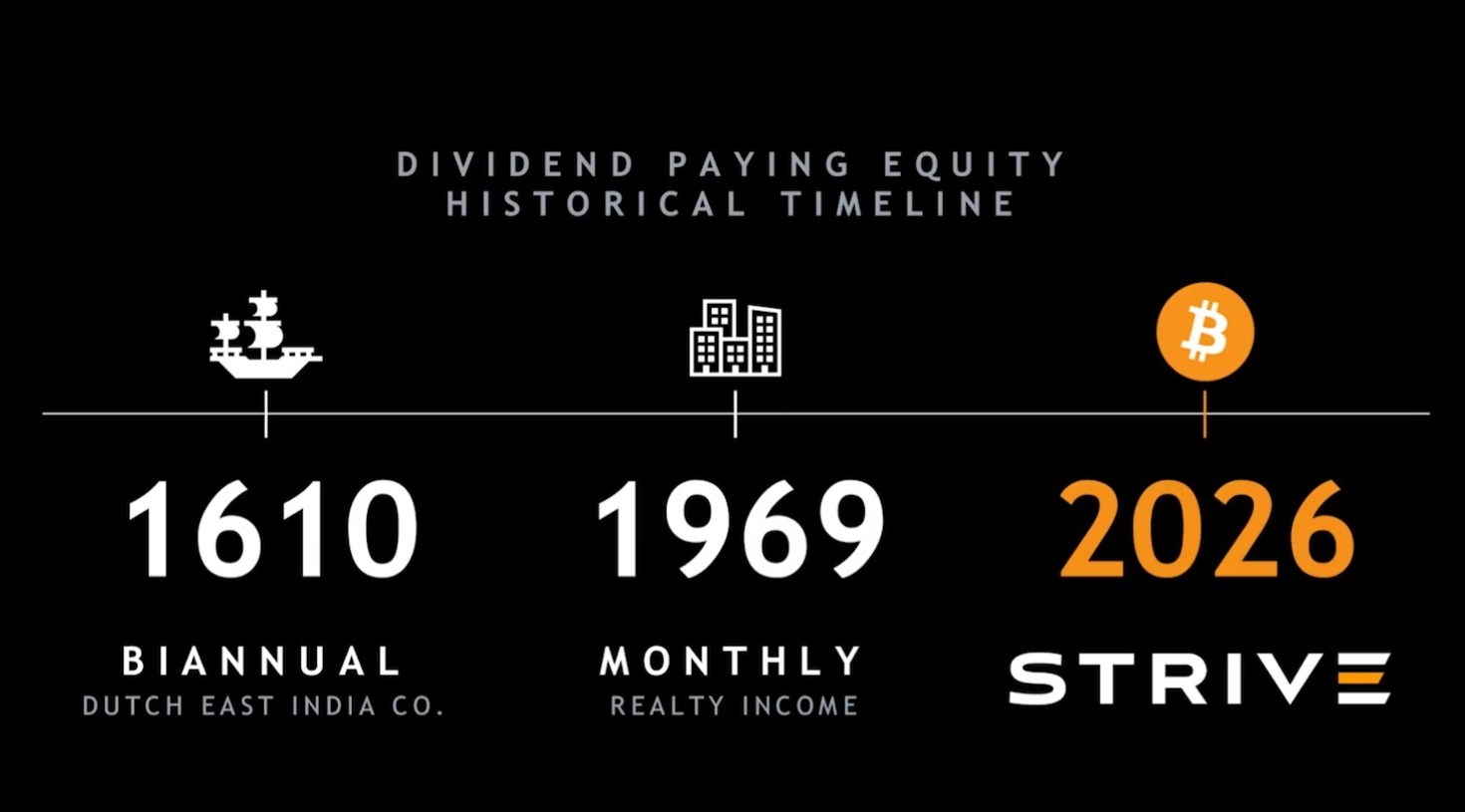
The comparison I keep coming back to is this: the Dutch East India Company paid dividends biannually in 1610. Realty Income made monthly dividends famous in 1969. Now in 2026, Strive is attempting to make daily dividends a new standard. Whether that becomes a lasting structural shift across the broader bitcoin treasury companies ecosystem remains to be seen — but the logic is hard to argue with.
For investors who want Bitcoin exposure without Bitcoin's volatility, and who want yield delivered more like a daily salary than a monthly paycheck, SATA is worth understanding carefully.
It's very encouraging to see the digital credit sector developing rapidly and Metaplanet will have more time to develop its own unique structured preferred shares in Japan while waiting for regulatory approvals.
Thank you for reading this insight and I hope you found it helpful. Check the latest prices of Metaplanet quoted on different exchanges at the link below Metaplanet-Trading-Hours
Disclaimer:
This article reflects my personal research and opinions and is for informational purposes only. It is not financial advice. I may be wrong, and markets are inherently risky. Always do your own due diligence and consult a licensed financial advisor before making any investment decisions.