The gap between retail fear and institutional conviction has rarely been wider or more meaningful. For those with a long-term view, the panelists are unanimous: the bottom is likely in, the next bull cycle is building, and the infrastructure being laid today will define the next decade of Bitcoin adoption.
Institutional Confidence Grows Even as Retail Sentiment Wavers
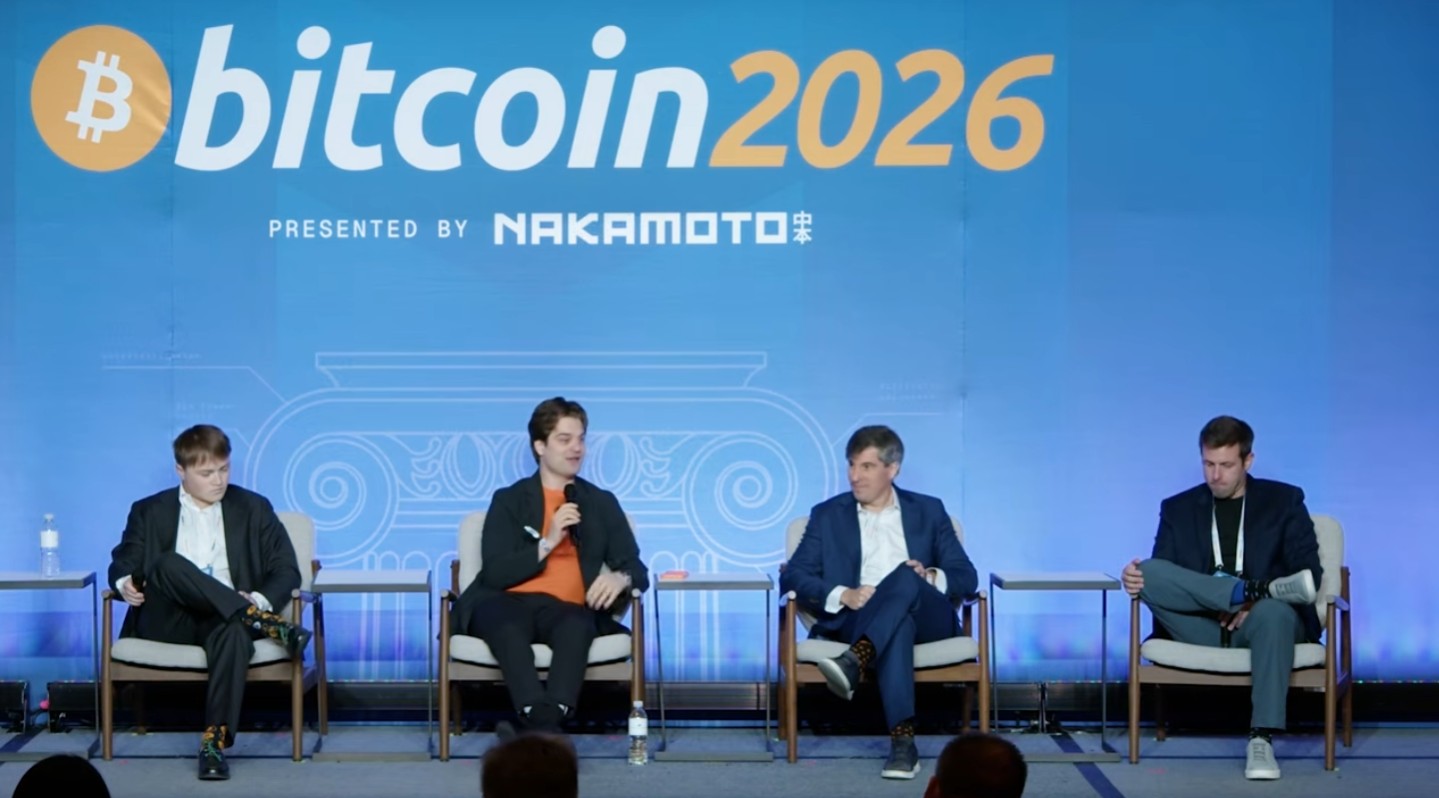
Panel: Dylan LeClair (Metaplanet) · Gui Gomes (OranjeBTC) · Nick Payton (BitGo) · Moderated by Mason Foard
Link to Video Here
Overview
At a morning panel session in Las Vegas, three of Bitcoin's most prominent institutional voices gathered to assess the current state of the market, examine global adoption trends, and map out the road ahead. Moderated by Mason Foard, Director of Bitcoin Strategy at Malthus and host of the True North podcast, the discussion featured Dylan LeClair (Director of Bitcoin Strategy at Metaplanet — the world's third-largest corporate Bitcoin holder), Gui Gomes (Founder & CEO of OranjeBTC — Latin America's largest Bitcoin treasury), and Nick Payton (VP of Marketing at BitGo — a leading institutional custody and infrastructure provider that recently completed its IPO).
The consensus: despite a significant price drawdown from 2025 highs, institutional Bitcoin adoption has never been stronger — and the next 12 to 24 months could be transformative.
Institutional Sentiment: Measured, Steady, and Bullish
Despite Bitcoin falling from highs near $126,000 to approximately $60,000 — a roughly 50% drawdown — panelists emphasized that institutional players have barely flinched.
Dylan LeClair: Bitcoin has been very much legitimized in the last two years. Most institutions dip their toe in and take four to six quarters to really get comfortable with an allocation and add. The sentiment is pretty good.
LeClair noted that Bitcoin's muted reaction to recent major headlines — both positive (Morgan Stanley launching a Bitcoin ETF) and negative (geopolitical conflict in the Middle East) — signals a market approaching an inflection point. He added that funding rates in perpetual futures markets are currently negative, meaning traders are actually being paid to hold long positions — a pattern that historically precedes bull market recoveries.
Gui Gomes: Institutions move at a much lower pace, but they don't change their minds as fast as retail. The drawdown is not impacting institutions as much.
Gomes highlighted a wave of institutional activity: Citibank announcing Bitcoin coverage as a service, Bank of New York Mellon expanding custody offerings, and Charles Schwab preparing to offer spot Bitcoin trading to its client base.
Nick Payton: The pipeline of institutional banks and nation states coming in — looking to do unique strategies, whether bonds, derivative markets — they're coming in with both hands. They're just slow.
Payton noted that major banks are increasingly interested at current price points, though many are still waiting for regulatory clarity — particularly around stablecoin legislation — before committing at scale. He also pointed out that reduced retail speculation is actually a healthy sign of market maturation, as institutional flows begin to dampen volatility.
Retail vs. Institutional: A Fundamental Misalignment
Moderator Mason Foard raised a key tension: the fear and uncertainty dominating social media and retail sentiment stands in stark contrast to the confidence expressed by institutional participants.
The panelists agreed this divergence is structural. Retail investors react emotionally to price action; institutions think in quarters and years. What appears to be a crisis on Twitter often looks like an entry opportunity on an institutional desk.
Key on-chain signals cited by LeClair include the short-term holder cost basis sitting around $80,000 per coin — well above current prices — while the broader market cost basis hovers near $55,000–$56,000. This spread historically marks the kind of capitulation zone from which bull markets re-emerge. Negative perpetual futures funding further underscores this thesis.
The Next 12–24 Months: Catalysts to Watch
All three panelists expressed strong conviction that the next one to two years will be pivotal. Key catalysts cited included:
• ETF track record maturation: BlackRock's Bitcoin ETF will cross its one-year mark, giving financial advisors more confidence to recommend it to clients.
• Corporate treasury adoption: Strategy (formerly MicroStrategy) approaches its two-year milestone, validating the corporate treasury model globally.
• Regulatory clarity: The Genius Act and other stablecoin/Bitcoin legislation moving through U.S. and international regulatory frameworks.
• Schwab's retail distribution: Charles Schwab arming its advisor network to actively pitch Bitcoin to mainstream retail clients.
• Monetary policy tailwinds: The incoming Fed chair and the administration's fiscal direction are expected to favor debasement-resistant assets like Bitcoin and gold.
• Nation-state adoption: Geopolitical fragmentation is driving sovereign entities to explore Bitcoin as a neutral settlement layer.
Geopolitics and the Global Settlement Layer
LeClair made one of the panel's most striking observations: the same week Morgan Stanley launched a Bitcoin ETF, an Iranian military checkpoint reportedly began accepting Bitcoin. This juxtaposition, he argued, illustrates Bitcoin's truly universal appeal — transcending ideology, geography, and political alignment.
Dylan LeClair: All the waterways are closed, airports are closed. If you have ten tons of gold in a vault in the UAE and you're trying to get out — what do you do? Bitcoin is permissionless.
He also noted that stablecoins — USDC and Tether — are being frozen amid the conflict, while Bitcoin continues to flow freely. This, combined with nations seeking alternatives to USD or yuan dominance, is accelerating Bitcoin's positioning as a neutral global reserve asset.
Nick Payton: All it's going to take is one G7 nation to decide Bitcoin is the settlement layer. Once that happens, everything downstream is impacted positively. That's what I'd be paying attention to.
Meeting Capital Where It Is: The Case for Bitcoin Products
LeClair offered a nuanced and often-overlooked point about what Bitcoin adoption actually looks like in practice. The vast majority of global capital — private credit funds, convertible bond funds, common equity portfolios — cannot buy Bitcoin directly or via ETF due to mandate restrictions.
Dylan LeClair: 99% of the money in the world can't buy Bitcoin ETFs. They can't buy spot, they can't self-custody. There's $10 trillion of private credit that can only buy private credit. Bitcoin winning means meeting the world and the money where they are.
This is why products like Bitcoin-backed convertible bonds, corporate treasury vehicles, and derivative instruments matter: they extend Bitcoin exposure to capital pools that would otherwise be entirely excluded. Far from diluting Bitcoin's core value proposition, these instruments are vehicles for adoption.
Regional Spotlights: Japan and Brazil
Both LeClair and Gomes offered valuable windows into how Bitcoin adoption is unfolding outside the United States.
Japan
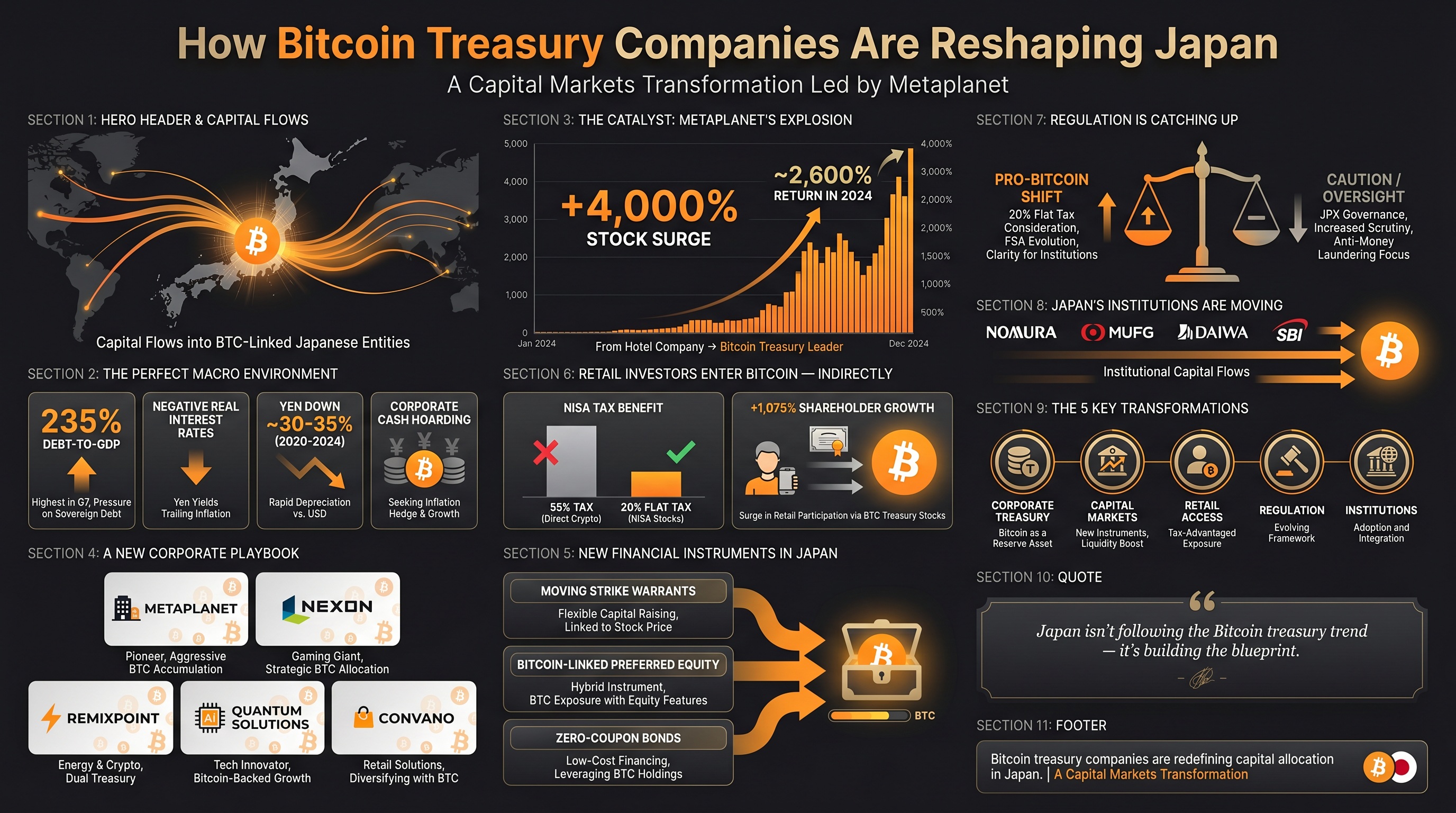
Metaplanet's rapid accumulation has prompted regulatory engagement in Japan, which is now reportedly approaching a 2023-equivalent inflection point — on the cusp of a wave of positive regulatory and market developments similar to what the U.S. experienced in 2024 with ETF approvals and accounting rule changes. Bitcoin is expected to gain status as a regulated financial asset, with stablecoin regulation already improving.
Brazil
Brazil presents a different dynamic. Retail adoption of both Bitcoin and stablecoins is among the highest in the world — driven by decades of currency devaluation and inflation. However, institutional adoption lags significantly; Gomes compared Brazil's current institutional landscape to where the U.S. was in 2020, when Strategy first emerged as a corporate treasury pioneer. OranjeBTC's mission is explicitly to accelerate that trajectory.
Gui Gomes: The country that needs Bitcoin the most is also one of the countries where it has the highest retail adoption. There's a lot of work to do on the institutional side, and we're happily doing so.
Payton added that in international markets — particularly Latin America and the Asia-Pacific region — Bitcoin's store-of-value and medium-of-exchange adoption curves appear to be developing simultaneously, unlike in North America where store-of-value has clearly led.
What Most People Aren't Watching
Each panelist offered a final, forward-looking observation for the audience:
Nick Payton: Pay attention to the global macroeconomic situation and what's happening at the nation-state level with settlement layers. One G7 nation embracing Bitcoin as the sole settlement layer — that's the Omega candle.
Dylan LeClair: The new Fed chair and the direction of U.S. fiscal and monetary policy over the next 18 months will be very positive for debasement trades — Bitcoin and gold.
Gui Gomes: The strength of this community. There are a lot of bears betting that this group of people, these brilliant minds and their drive, will not eventually win. I'm pretty bullish that the power of the community will continue to take Bitcoin to new places — and eventually make it a world reserve asset, as it should be.
Bottom Line
The gap between retail fear and institutional conviction has rarely been wider — or more meaningful. For those with a long-term view, the panelists are unanimous: the bottom is likely in, the next bull cycle is building, and the infrastructure being laid today will define the next decade of Bitcoin adoption.
Disclaimer: This article reflects my personal research and opinions and is for informational purposes only. It is not financial advice. I may be wrong, and markets are inherently risky. Always do your own due diligence and consult a licensed financial advisor before making any investment decisions.